
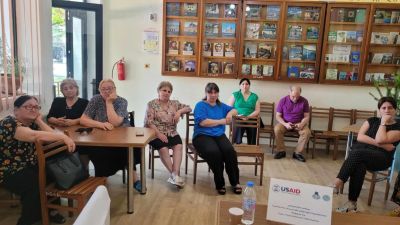


An initiative group of IDP women in Senaki joined the research process. The survey will identify problems and challenges that are actual in collective centers of different status. 40 families will be interviewed in Senaki municipality. As a result of the survey, a social profile of collective centers and privatized facilities will be formed.
A consultation meeting was held with members of the Initiative Group. The group is prepared for the survey.
The project is implemented with the support
of the UN Women organization
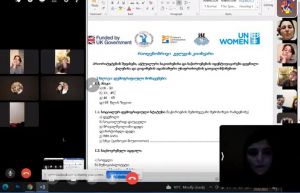
Online training was held with members of Tskaltubo IDP Women Initiative Group. The participants reviewed the methodology for conducting needs research and also shared their experience of participating in surveys with each other.
During the training, they talked about practical work with respondents and data collection, about filling out online questionnaires, conducting focus groups and in-depth interviews. The participants got acquainted the questionnaire and received the necessary advice.
The project is implemented with the support
of the UN Women organization
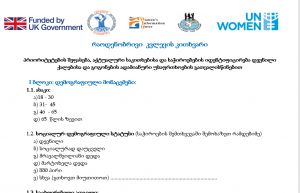
The practice of target groups’ needs research was discussed at the training with Khoni IDP Women Initiative Group. Participants were provided with comprehensive information on conducting quantitative and qualitative research online. They talked about practical work with groups and data collection.
The training was based on practical advices and examples. Participants were particularly interested in the detailed discussion of the online questionnaire, expressing their views on the content of the questionnaire.
The project is implemented with the support
of the UN Women organization
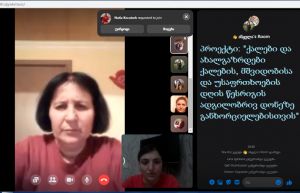
The methods and skills for conducting needs research, the technique of collecting quantitative and qualitative data - these topics were highlighted at the online training, with members of Kutaisi Initiative Group of IDP Women.
The participants discussed the questionnaire template, recorded their opinions, expectations and shared their experiences with each other.
The work is carried out within the framework of the project "Women and Youth for Implementation of the Peace and Security Agenda at the Local Level".
The project is implemented with the support
of the UN Women organization
Within the framework of the project "Women and Youth for Implementation of the Peace and Security Agenda at the Local Level", training was held for the members of Senaki IDP Women Initiative Group. Participants heard information on methods and skills for conducting needs research.
The following issues were discussed: what are the risks of the process of collecting quantitative and qualitative data, how important it is to select the target beneficiaries. Practical exercises on facilitation techniques and skills were done.
The conducted work will help to the members of the group, as they will be directly involved in the research process from the next month.
The project is implemented with the support
of the UN Women organization
The training was held with the members of Zugdidi IDP Women Initiative Group, where they discussed the practice of target groups’ needs research of the target groups.
Participants talked about their strengths and weaknesses, the experience of participating in research.
The group members received comprehensive information on the following issues: techniques of quantitative and qualitative research; How to fill in the online questionnaires, how to conduct a focus group and in-depth interview.
Through the presentation, participants learned about the sample questionnaire and received practical advices. Despite the online format, the meeting turned out to be interesting and active.
The project is implemented with the support
of the UN Women organization
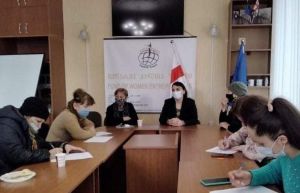
Working on IDP issues is one of the directions of the Women Fund "Sukhumi". A coalition project has been launched in five municipalities of western Georgia. The title of the project is:
Strengthening the capacities of the regional and local administrations in the processes of localization of the National Action Plan on Women, Peace and Security and enhancing the meaningful participation of IDP and conflict-affected women and youth in those processes.
The aim of the project is to support the development of local government capacity, especially with IDPs and conflict-affected population, to be more actively involved in the localization of the National Action Plan of UN Security Council Resolution 1325 for Women, Peace and Security.