
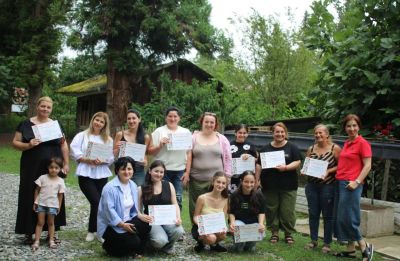
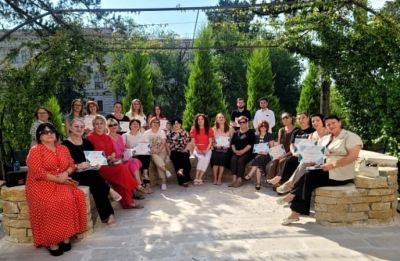
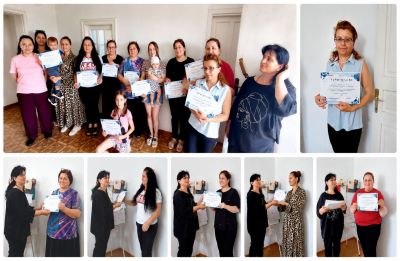
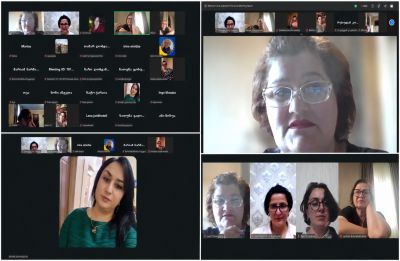
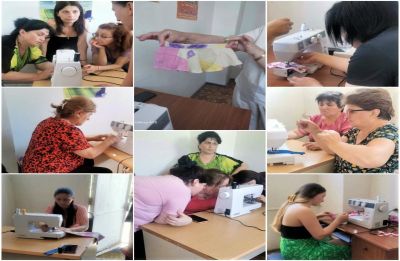
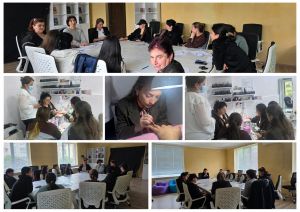
A new initiative of Women Fund “Sukhumi” has started in Khoni — a gel polish training course that creates an opportunity for women to develop practical skills and strengthen their economic prospects.
On May 1, representatives of the Fund met with the women’s group to learn more about their interests and needs. Today, the participants have already started the learning process.
Within the course, women are mastering gel polish techniques, gaining new professional knowledge, and taking an important step toward self-employment and financial independence.
For the participants, this initiative is not only an opportunity to learn a new profession, but also a space where knowledge, motivation, and support strengthen one another.
The project is implemented with the support of CISU
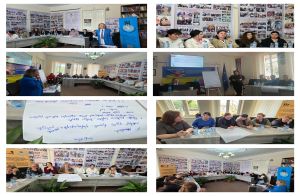
In Kutaisi, Ekaterine Gamakharia, Head of the Tbilisi Representative Office of the Charity Humanitarian Women Fund “Sukhumi”, conducted a training on the topic: “Trauma-Informed Approach and Understanding the Dynamics of Violence in Working with Women Survivors of Violence.”
The training brought together para-specialists and community leaders who work with women survivors of violence in their daily practice. The aim of the meeting was to strengthen participants’ capacity to apply a trauma-informed approach and to deepen their understanding of the dynamics of violence.
During the training, participants discussed the social roots of violence, the influence of gender norms and stereotypes, violence as a system of control, the cycle and spiral of violence, as well as the impact of trauma on women’s behavior and decision-making.
Special attention was given to practical cases, group work, and the principles of trauma-informed communication. Participants reflected on how women’s reactions and behavior can be understood within the context of trauma, and how to create a safe, non-judgmental space in the support process.
The meeting once again highlighted that working with women survivors of violence begins with understanding, sensitive communication, and recognizing the experiences that affect women’s decisions and emotional state.
The project is implemented with the support of CISU
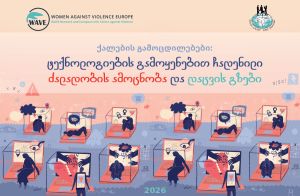
Women’s Experiences: Recognizing Technology-Facilitated Violence and Ways to Protect Yourself is a brochure that brings together stories based on women’s experiences, showing how, in intimate partner relationships, technologies can become tools of control, surveillance, blackmail, financial pressure, and intrusion into personal space.
The brochure helps readers recognize the early signs of technology-facilitated violence, explains why responsibility never lies with the woman who has experienced violence, and offers practical advice on digital safety, preserving evidence, and seeking support. The publication was prepared by the Women Fund “Sukhumi” within the framework of the project “No Longer Invisible: Recognizing and Responding to Technology-Facilitated Violence in Intimate Partner Relationships”, with the support of the WAVE Network.
The project is implemented with the support of the WAVE Network
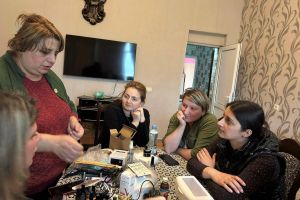
A one-month basic manicure training course has started in Senaki, aimed at supporting women’s economic empowerment. Ten women are participating in the program.
The course is led by Nestani Dadiani, a specialist with 20 years of experience in this field. The participants have already received the necessary materials and equipment. The first two lessons have also been conducted.
The program gives participants an opportunity to acquire new practical skills and consider employment or self-employment opportunities. At the same time, the course serves as a space where, alongside learning, women strengthen their confidence in their own abilities and their motivation toward economic independence.
Such initiatives play an important role in creating new perspectives for women and helping them plan a more stable future.
The project is implemented with the support of CISU

A workshop on the topic “Identifying, Supporting, and Responding to Domestic Violence Against Women in Local Communities” was held in Geguti village, Tskaltubo Municipality. The meeting brought together 10 women.
During the workshop, participants received information about different forms of domestic violence, ways to identify them, and available support services. Special attention was given to less visible forms of violence that are often difficult to recognize.
The meeting was conducted in an interactive format. Participants shared their views and experiences. According to them, such meetings strengthen mutual support and increase readiness to seek and provide help when needed.
The project is implemented with the support of CISU
Based on the brochure prepared by Women Fund “Sukhumi” - “Women’s Experiences of Different Forms of Violence” - a video has been created that brings together the stories of three women.
The video presents the experiences of Ana, Lia and Tea, clearly illustrating that violence against women manifests in different forms - including psychological pressure, physical aggression, and situations where a woman seeks help but the system fails to provide effective protection.
The video aims to support the recognition of different forms of violence, raise awareness on the issue, and highlight the importance of support for women.
The project is implemented with the support of the organization Brot
für die Welt - Evangelischer Entwicklungsdienst (Germany)
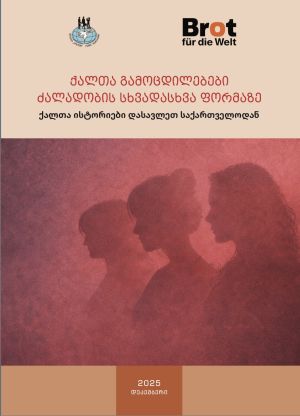
The new brochure prepared by Women Fund “Sukhumi” - “Women’s Experiences of Different Forms of Violence” - brings together stories of women living in different municipalities of Western Georgia.
The publication shows how violence against women manifests itself in different forms - including psychological, physical, economic and digital violence, as well as institutional barriers - and why these experiences so often remain invisible and unspoken.
The brochure is based on the research conducted by Women Fund “Sukhumi” and on data collected by its monitoring group. The stories included in the publication have been adapted and the names changed for women’s safety. Its aim is to help identify violence, break the silence, and raise awareness of available support services.
The project is implemented with the support of the organization Brot
für die Welt - Evangelischer Entwicklungsdienst (Germany)
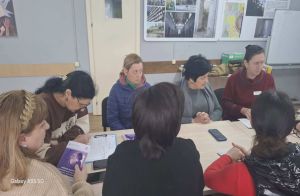
One – year project aimed at strengthening social work in IDP communities has been successfully completed. The aim of the project was to study community needs, identify challenges, and support concrete initiatives.
In frames of the project, Senaki mutual assistance group implemented two initiatives. One of them involved the creation of an isolated eco-park with recreational toys. This is a comfortable and safe space for mothers and children.
Participants of the initiative assessed the project's impact using an online questionnaire. They noted a significant increase in community activity and engagement, which is considered a positive outcome. The women's group has plans for the future and believes that similar initiatives should be continued.
The project is implemented by a coalition of non-governmental organizations: the Association of IDP Women "Consent," the Women's Information Center, and Charity Humanitarian Women Fund “Sukhumi”.
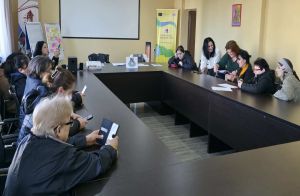
Members of the mutual assistance group and the Network of Women and Youth Peace Ambassadors attended the meeting in Khoni.
Participants summarized the project results and noted the importance of the training cycle for acquiring knowledge and skills. They spoke about civic initiatives implemented in the community and expressed gratitude to the Women Fund “”Sukhumi, partner organizations, and donors.
The women are proud and pleased with the results of their work. Their community has gained increased trust, and if the project continues, many women are willing to actively participate in identifying and addressing community issues.
According to members of both groups, much work still needs to be done and they look forward to further collaboration with the Fund “Sukhumi”.
At the end of the meeting, the participants completed an anonymous online survey to determine how their perceptions of safety, well-being, and access to essential services have changed.
The project is implemented by a coalition of non-governmental organizations: the Association of IDP Women "Consent," the Women's Information Center, and Charity Humanitarian Women Fund “Sukhumi”.
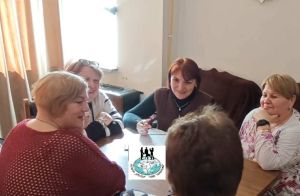
Poti mutual assistance group meeting was dedicated to summarization of the work done. The project's achievements in terms of empowering women and the changes implemented in the community were assessed.
Particular attention was paid to civic initiatives, which became one of the most important stages of the project. These initiatives not only addressed community problems but also inspired other women to get involved.
The group members shared their experiences and positive emotions with each other. They noted that participation in the project increased their self-confidence, strengthened their teamwork skills, and gave them the opportunity to actively participate in the problem-solving process.
The community still faces many unresolved issues. That's why they use various mechanisms of civic participation and actively collaborate with local government.
At the end of the meeting, the participants once again expressed their gratitude for the support. They hope that their collaboration with our organization will continue and that positive changes will happen in the IDP community.
The project is implemented by a coalition of non-governmental organizations: the Association of IDP Women "Consent," the Women's Information Center, and Charity Humanitarian Women Fund “Sukhumi”.